
Solutions — 04
Drone Inspection & Condition Assessment
Industrial rope access, aerial platforms and manual site visits quickly hit their limits on large or hard-to-reach structures — in cost, time and safety.
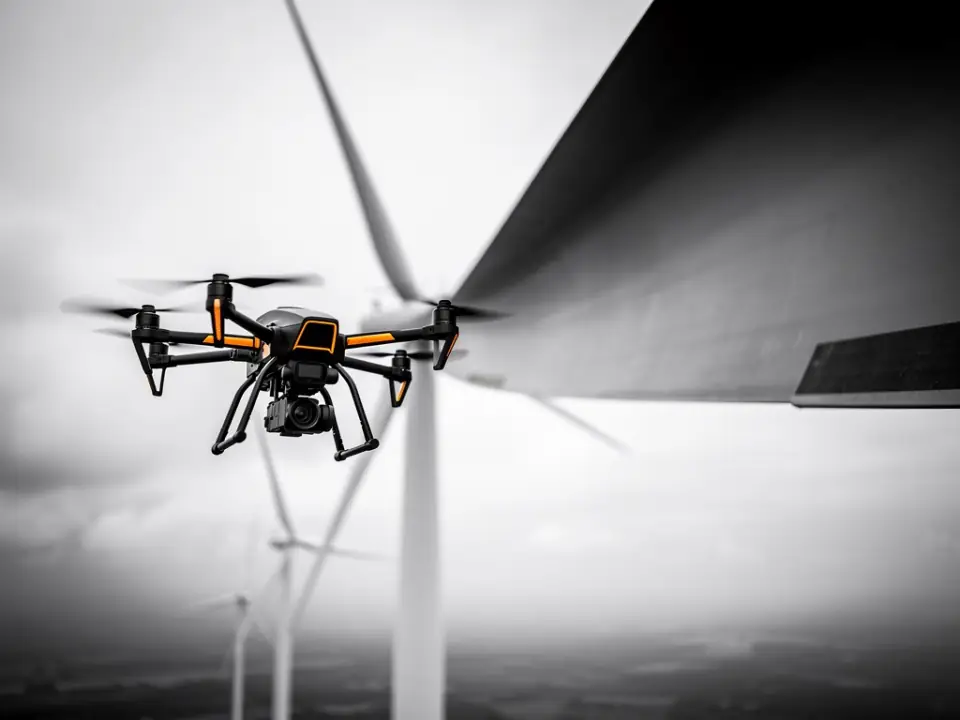
Dronium conducts drone inspections of wind turbines, bridges and structures, industrial plants and chimneys, high-voltage overhead lines, and rail infrastructure. High-resolution optics and thermal imaging capture damage, wear and anomalies precisely and reproducibly, with exact GPS positioning. Results are delivered as structured inspection reports — compliant with TÜV, DEKRA and industry safety-body requirements.
Every inspection follows a standardised flight pattern tailored to the asset — a spiral approach around turbine blades or chimneys, for example, or a linear flight along power-line corridors. Optical and thermal imagery is georeferenced and compared in the DroniumApp against previous surveys, so wear and new damage can be tracked objectively over time. Anomalies are flagged automatically and linked to a structured inspection report that can be imported directly into existing maintenance systems.
Why drone inspection is redefining inspection itself
Conventional inspection methods have three structural drawbacks: they're slow, they're expensive, and they put people in dangerous situations. Scaffolding has to go up, areas have to be closed off, operations grind to a halt. Rope-access teams need equipment, safety plans and favourable weather. And at the end of the day, the resulting reports rest on human judgement — subjective, incomplete, rarely reproducible.
Drone inspection solves these problems systematically. A drone reaches, in minutes, places that are difficult or impossible for people to access. It captures surfaces from just a few centimetres away, delivers high-resolution images and video, and uses thermal cameras to reveal damage that isn't yet visible to the eye. The entire inspection process becomes faster and cheaper, and runs without interrupting operations.
There's also a decisive advantage that's often underestimated in practice: repeatability. Dronium drones fly precisely defined inspection routes — identical every time. That's what makes condition comparisons over time possible in the first place, and it's the foundation for predictive maintenance instead of reactive repair.
Our inspection services in detail
Wind turbines
Wind turbines are among the most demanding inspection tasks there are. Rotor blades 60 metres long or more, working at height, under changing weather conditions — all while minimising downtime. Manual inspections mean shutting the turbine down, deploying rope-access teams, and often days of lost production.
Dronium inspects wind turbines by drone without taking the turbine out of service. Our UAV systems capture blades, nacelles and towers with high-resolution cameras and thermal sensors. Cracks, delamination, leading-edge erosion, lightning-strike damage and structural anomalies are documented precisely, with exact GPS positioning on the component, so repair teams can be deployed exactly where they're needed.
The captured data flows directly into the DroniumApp, where findings are classified, prioritised and compiled into a structured inspection report. On request, Dronium also handles ongoing monitoring of entire wind farms, with automated routines and trend analysis across multiple inspection cycles.
Bridges and structures
Bridges, tunnels, retaining walls and engineering structures have to be inspected regularly under DIN 1076 and comparable standards. Traditionally, that means aerial platforms for close-up and overview inspection, extensive traffic closures, and high costs per inspection cycle.
Drone inspection cuts that effort dramatically. Dronium drones capture abutments, substructures, superstructures, piers and bearings at close range — without disrupting traffic, without closures, in a fraction of the time. High-resolution close-ups reveal cracks, spalling, corrosion damage or drainage problems in a level of detail that visual inspection from the ground simply can't match.
Data is georeferenced and documented in standardised damage logs. For engineering firms and public works authorities, Dronium offers direct integration with bridge management systems such as SIB-Bauwerke.
Industrial plants and chimneys
Chimneys, cooling towers, silos, tanks and refinery towers are some of the most hazardous inspection targets there are. Heights of 100 metres or more, confined structures, fall risk — yet regular inspection is required, often by law.
Dronium removes the risk for inspectors entirely. Our drones climb to full height, circle chimneys and cooling towers, and inspect welds, corrosion, lining damage and structural anomalies — completely, reproducibly, and without a single person working at height. Combining high-resolution optics with thermal imaging enables both visual damage documentation and detection of heat loss, leaks or dangerous hot spots in industrial processes.
For operators of chemical plants, power stations or cement works, that means inspection intervals can be met economically, downtime is minimised, and documentation satisfies TÜV, DEKRA and industry safety-body requirements.
Power lines and overhead transmission
High-voltage overhead lines run for hundreds of kilometres, often through terrain that's hard to access — forests, mountains, wetlands. Regular inspection is mandatory for grid operators, but extremely labour-intensive with conventional methods: helicopter surveys are expensive, and ground patrols are slow and incomplete.
Drone-based line inspection is the most efficient alternative. Dronium systems follow overhead lines on exact parallel routes, capturing pylons, conductors, insulators and fittings in high resolution while combining optical with thermal imagery. Overheated connections, damaged insulators, corrosion at pylon bases or vegetation encroachment are reliably detected and precisely located.
After every flight, Dronium delivers a structured findings report that imports directly into the grid operator's network information systems. On request, the inspection can be combined with LiDAR data for precise clearance calculations between the line and surrounding vegetation, and exact corridor profiles.
Rail and railway infrastructure
Track systems, rail bridges, tunnel portals, overhead line equipment and embankments along railway routes have to be inspected regularly, under pressure to keep line closures to an absolute minimum. Dronium carries out drone inspections along rail routes that fit exactly around the operator's schedule — within possession windows, in the early morning, or in sections between services.
Our UAV systems capture track geometry, points and crossings, retaining walls, embankments and structures such as overpasses and tunnels in high detail. Thermal imagery reveals cracking in concrete structures, moisture in embankments, or thermal anomalies in electrical components of the overhead line. Results are delivered as georeferenced datasets that import directly into route information systems.
Every sensor type communicates directly with the DroniumApp and automatically triggers predefined drone missions when relevant events occur. Ground sensors form the early-warning layer; the drone is the immediate response.
DroniumApp: from finding to report
Inspection data is only valuable if it can be evaluated quickly and communicated clearly. The DroniumApp covers the entire inspection process — from mission planning through automated data capture to structured findings documentation.
During the flight, every image is automatically linked to GPS coordinates, timestamps and camera parameters. After the flight, operators can mark, classify and annotate findings directly in the app. Priorities are assigned by severity, and recommended actions are recorded. The finished inspection report can be exported as a PDF, as a structured dataset, or straight into asset management systems via API.
For operators with recurring inspection needs, the DroniumApp enables direct comparison between inspection cycles: damage is tracked over time and changes are flagged automatically. Individual snapshots become a continuous condition history — the foundation for data-driven maintenance planning.
Legal certainty and certification
Drone inspections in industrial settings are subject to clear requirements: EASA compliance, operating permits in controlled airspace, data protection rules and, in many cases, specific requirements from the relevant operator or inspection body. Dronium operates entirely within these requirements.
Every UAV system we deploy is approved and certified. Our pilots hold the necessary remote pilot licences plus additional qualifications for operating in industrial environments, near high-voltage equipment, and in controlled airspace. For inspections that require specific evidence — for TÜV acceptance testing or industry safety-body audits, for example — Dronium provides complete documentation of the inspection process.
Why Dronium for your inspection needs?
Offering drone inspections is easy. Carrying them out professionally, in full legal compliance, and with genuinely usable results is a different matter. Dronium brings both together: the technical equipment for demanding industrial environments, experience from hundreds of inspection missions, and in-house software that covers the entire process — from planning to report — on a single platform.
We work with grid operators, industrial companies, public works authorities and rail maintenance providers. We understand what these industries need in data quality, documentation and process integration — and we deliver results that fit into existing systems without extra work for your teams.
→
Benefits at a glance
- No personnel exposed to dangerous heights or hard-to-reach areas
- Objective wear tracking through automated comparison with previous surveys
- Legally compliant documentation to TÜV, DEKRA and industry safety-body standards
- Significantly shorter downtime than conventional site visits
→